
Concrete finishes
Honest material.
Distinctive character.
Tactile countertops. Quiet hearths. Architectural surfaces with weight, depth, and the unmistakable character of a hand-finished material.
Imagine it in your space Explore the possibilities ↓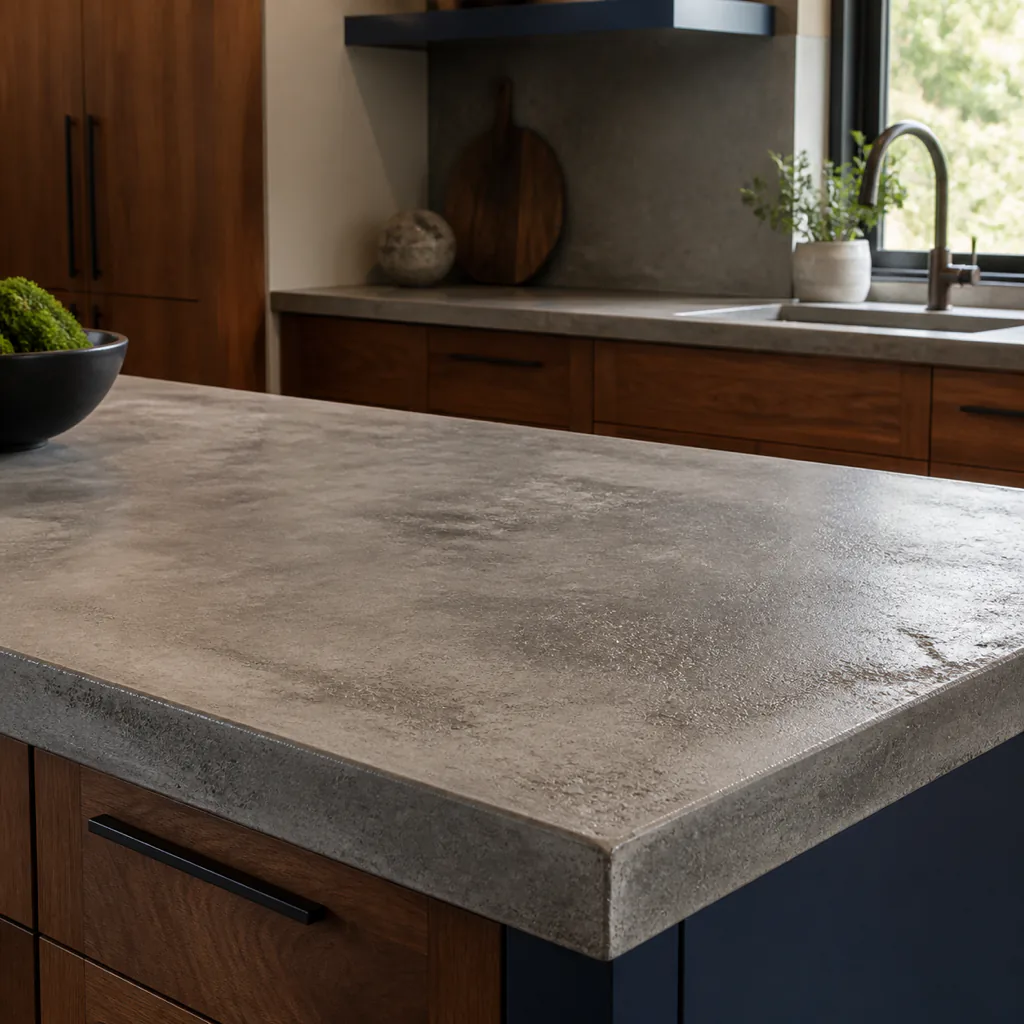
The feeling of the finish
A surface with a point of view.
Color, pores, edges, and subtle variation give concrete its presence. We work through the form and finish with you, balancing the look you love with everyday use.
Beautifully considered, from the beginning
The look you love.
The details handled.
We start with your idea, review the space, and work through samples and a clear proposal. You can explore the practical details below, or simply begin with a conversation.
Let’s talk about your space ↗Is this finish right for my space?
Concrete and hand-applied overlays are not stone-print substitutes. Variation, pores, edges, seams, patina, and maintenance need to be understood rather than marketed away.
- Is the existing base structural, stable, and suitable for the proposed build?
- Where are seams, edges, corners, penetrations, sinks, heat, and transitions?
- What movement, cracking, moisture, drainage, or freeze exposure exists?
- How will staining, heat, scratching, patina, and maintenance be handled?
- What color, pore character, movement, sheen, and edge language are acceptable?
- What sample or mockup is needed before final scope?
Materials & preparation
Cast or formed concrete directions
Considered around structure, reinforcement, thickness, weight, seams, edges, penetrations, heat, finish protection, and installation logistics.
Compatible overlay systems
Selected only after the base, bond, movement, edge build, exposure, color, texture, and protection requirements are confirmed.
Selected Leggari concrete finishes
Considered from current project-specific documentation when the intended use, substrate, finish build, protection, and care align.
Can an overlay fix damaged concrete?
An overlay is a finish, not structural correction. Active movement, failed base, deep deterioration, drainage problems, or unsuitable edges require repair, redesign, or exclusion first.
Will a concrete countertop stain or develop patina?
Use, protection, cleaning, heat, acids, oils, standing water, and maintenance all matter. The selected system and care plan should make those expectations explicit.
Can the final surface match a sample exactly?
No sample reproduces every variable at full scale. It sets the intended range for color, movement, pores, texture, edge treatment, and sheen.
Is an overlay always less work than replacement?
Not always. Existing condition, edges, appliances, penetrations, movement, preparation, access, and desired build can make replacement or another solution more appropriate.
Your space, beautifully considered
What would you
love to come home to?
Tell us a little about your idea. We’ll help you find the finish.
Start a conversation Based in McMinnville · Serving the surrounding wine country and west metro